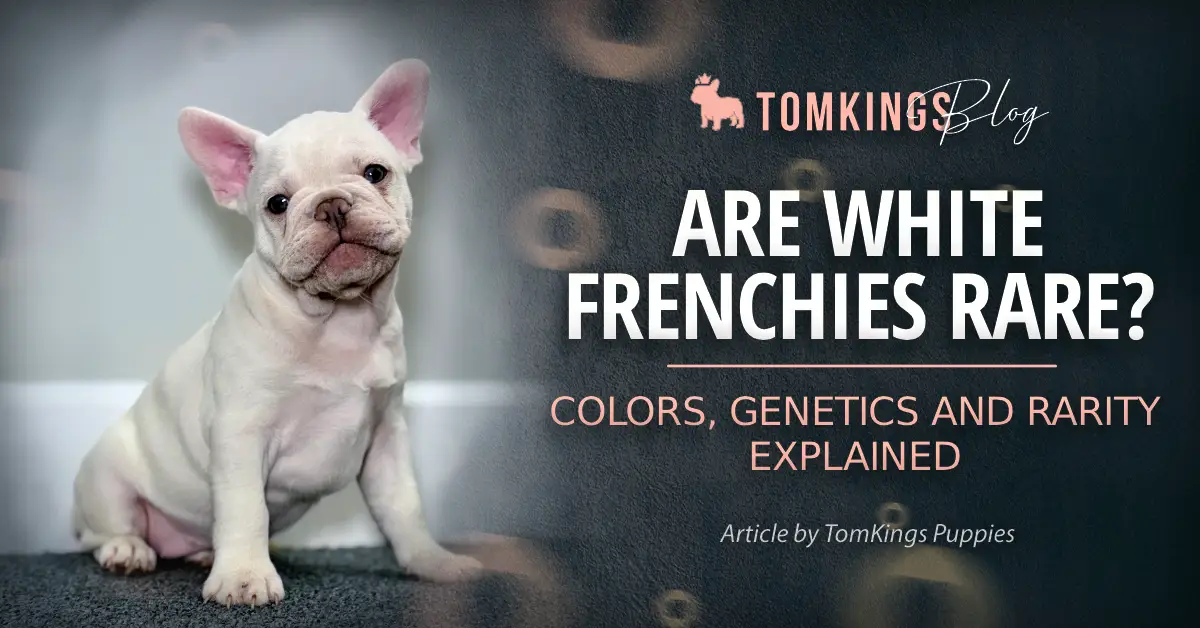
If you’ve ever seen a completely white French bulldog and stopped for a second, we get it. There’s something incredibly striking about that snowy coat paired with the typical Frenchie face and bat ears.
But here’s something many people don’t realize: a French Bulldog that looks white isn’t always genetically white. Very pale cream, platinum and extreme pied Frenchies can all appear almost snow-white, especially in photos.
At TomKings, we’ve been caring for French Bulldogs for more than 15 years, and we’ve seen almost every color combination you can imagine. Yet in the entire history of TomKings, we’ve had only three truly white Frenchies. Considering how many puppies have grown up with us over the years, that gives you a pretty good idea of just how special they are.
In this article, we’ll explain why a white French Bulldog is so rare, how white differs from cream, platinum and pied, and what genetics and health have to do with it.
Key Takeaways
- A genuinely full white French Bulldog is extremely rare. In TomKings history, we’ve had only three.
- Many Frenchies that look white are actually very pale cream, platinum, albino (also known as pink) or extreme pied.
- White coloring itself doesn’t automatically mean health problems. The genetic background and responsible breeding matter much more.
Why Do White French Bulldogs Stand Out So Much?
French Bulldogs come in an amazing variety of colors and patterns. You’ll find traditional shades such as brindle, fawn and cream, as well as rarer colors like blue, lilac and Isabella.
White Frenchies are different because their coat creates such a strong contrast with their eyes, nose and facial features. They often look almost unreal!
And this is where things can get confusing. Two puppies may both look white to you, but one could be cream and the other platinum, pied, or albino (lately referred to as pink). Their coats may appear almost identical while their genetics are completely different.
So, if you fall in love with a white-looking Frenchie, there’s one question worth asking: what color is this puppy actually?
Are White French Bulldogs Really Rare?
Yes. If we’re talking about a genuinely all-white Frenchie, they’re very, very rare!
Very light Frenchies themselves aren’t necessarily unusual. Cream Frenchies can become so pale that they look white. Platinum Frenchies can have a light, almost silvery coat, while an extreme pied puppy may have such tiny colored areas that you barely notice them.
In all our years at TomKings, we’ve had only three genuinely white French Bulldogs. That’s not something we see every year or even regularly across many litters.

What’s the Difference between Cream, Platinum and Pied Frenchies?
If you put a pale cream, platinum and extreme pied Frenchie next to each other, an untrained eye might simply call all three “white.” Once you know what to look for, the differences become much easier to spot. To explain, we asked Dan, our breeding expert, who works closely with the genetics behind our breeding program.
Cream French Bulldogs
Cream Frenchies usually have a soft ivory or pale yellow coat. Some are so light that the yellow tone is almost invisible unless you see them in natural light.
They generally keep darker pigmentation around the nose, eyelids and paw pads.

Dan explains what’s happening genetically:
“With cream, the e/e combination at the E locus prevents dark eumelanin from showing in the hair, and the intensity (I locus) genes can make the remaining color extremely pale. That’s why some cream Frenchies can look almost completely white.”

Platinum French Bulldogs
Platinum Frenchies can also look white, but genetically they’re different again.
Their coat may look cream, off-white or slightly silver, while they carry other color genetics underneath. Depending on those genes, you may hear terms such as lilac platinum or Isabella platinum.

Platinum Frenchies can also look white or off-white. Like standard creams, they are homozygous recessive for cream (e/e at the E locus), which blocks eumelanin in the coat and leaves only pheomelanin. What makes a Frenchie platinum is that it also carries double recessives for other dilutions: blue (d/d) plus either cocoa (co/co, lilac platinum) or chocolate (b/b, Isabella platinum). These genes stay hidden in the coat but still affect the skin and eyes, so platinum Frenchies tend to have lighter, pinkish or greyish noses, paw pads, and eye rims, unlike the black-nosed standard cream.

A cream dog that is d/d but has no brown gene is usually called a champagne rather than a platinum. Its nose, paw pads, and eye rims are more likely to be bluish-grey than pinkish or pale brown. Breeders don’t agree on the naming, though, and some call any cream dog that is also d/d “platinum,” no matter which other genes it carries.
Some platinum dogs can look almost white. This is thought to come mainly from the cream genotype combined with an intensity variant that lightens pheomelanin, rather than from the dilution genes themselves.
Pied and Extreme Pied Frenchies
Pied is a pattern rather than a single color. Pied Frenchies have large white areas combined with patches of another color. Contrary to popular belief, a pied Frenchie isn’t a white dog with colored patches. Scientifically, it’s a colored dog (fawn, blue, or black) with white patches overlaying the base coat.

Sometimes those colored patches become very small. You may only see one around an ear, near the eye or beside the tail.
Dan explains why this happens:
“During embryonic development, a mutation at the genetic S-locus disrupts the normal spread of pigment-producing cells across the dog’s skin. As these cells migrate, they fail to reach certain areas of the body before the skin fully forms. These unpigmented patches grow hair without any color, resulting in white spots overlaid on the dog’s base coat. So even though it may look a little unusual, it’s completely healthy and simply a natural variation in pigmentation.”
So yes, two nearly identical white-looking puppies can actually have very different genetics.
What Genetics Can Make a French Bulldog Look White?
By now, you’ve seen that there isn’t one single “white Frenchie gene.” Cream and pied can both create an almost-white appearance, but they do it in very different ways. There’s also a third mechanism that needs to be separated from both: albinism (also known as pink).
Dan sums up the difference simply:
“Pied affects pigment distribution, cream affects what pigment shows in the hair, and albinism affects pigment production itself. They may look similar from a distance, but biologically they’re very different.”
True albinism happens when melanin production itself is disrupted: the pigment cells are present but can’t make normal amounts of melanin. It is autosomal recessive, DNA tests can check for known albinism variants.
The important part? Most white-looking Frenchies aren’t albino.
Is a White French Bulldog the Same as an Albino Frenchie?
Not at all! This is one of those questions we hear surprisingly often, but a white coat doesn’t automatically mean albinism.
A useful clue is to look beyond the coat. Platinum, pied and cream Frenchies can still have normal pigment in places like the nose, eyes and skin.
“With true albinism, the problem is pigment production itself. An albino Frenchie has no colored patches at all, just a white coat, pink skin, and a pink nose, eye rims, and paw pads, often with very pale eyes and sensitivity to bright light and sun,” Dan explains.

True albinism is extremely rare in French Bulldogs. A white coat or a small pink area on the nose isn’t enough to call a Frenchie albino.
Do White French Bulldogs Have More Health Problems?
Being white doesn’t automatically make a Frenchie unhealthy.
This is especially important to us because families sometimes see a very unusual puppy and immediately worry that the color must come with a problem.
One question we get quite regularly is: “Could they be deaf?”
Dan explains where this concern actually comes from:
“Some forms of extreme white pigmentation, especially around the head and ears, can be associated with a higher congenital hearing risk. But that’s not the same as saying white Frenchies are deaf. The actual genetics and the breeding behind the puppy matter.”
We spend time with our puppies every day from a very young age. We see how they react when we speak, when a door opens, when their siblings start playing or when normal sounds happen around them. A major hearing problem would affect those reactions and become noticeable.
There’s also a completely separate situation with double merle genetics, where hearing and eye problems can become much more serious. This is exactly why you can’t group every white-looking Frenchie into the same category.
For us, it always comes back to the same thing: know your Frenchies, understand the genetics and plan every pairing responsibly!
What is a double merle Frenchie?
A double merle (M/M) Frenchie can be mostly or even entirely white, and producing one is a serious welfare concern. Merle is a semi-dominant variant: one copy creates the familiar patchy, lightened coat, while two copies can remove most of the pigment.
This white appearance is not a rare or desirable color. It’s a sign that pigment cells didn’t develop properly. Because of this, double merle dogs are often mostly white, with pink-toned skin and blue, very pale, or sometimes malformed eyes.
Pigment cells are also important for the development of the inner ear and the eyes. That’s why double merles have a much higher risk of deafness and eye problems, including microphthalmia, missing irises, and blindness.
Double merles are produced only by breeding two merle Frenchies together, which is why most breed organizations strongly discourage merle × merle pairings.
There’s one more important detail: a cream or white-looking Frenchie can carry merle without showing the typical pattern. In other words, a dog that looks plain can still pass the merle gene on and produce double merle puppies. A DNA test for the PMEL variant is the only way to know for sure, which is why every white or cream Frenchie should be tested before breeding.
So yes, a double merle can look white, but this isn’t a rare color anyone should try to produce. It comes with serious health risks, and at TomKings, we would never breed two merle Frenchies together.
How Is White Different From Blue or Lilac French Bulldog Genetics?
White and dilute colors such as blue or lilac are genetically different. By appearance they are completely different.
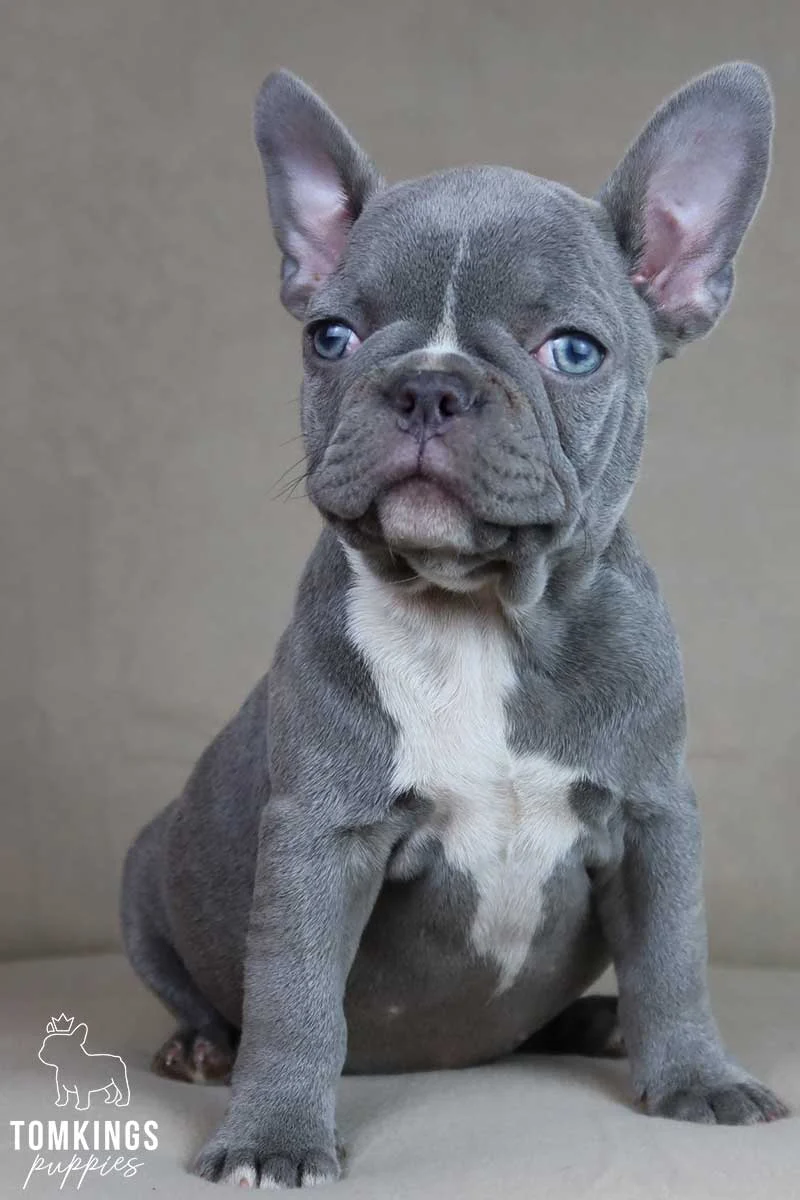
Blue Frenchies carry two copies of the dilution allele, known as d/d. Lilac involves dilution together with chocolate-related genetics.
That means a white Frenchie doesn’t automatically have risks sometimes discussed in connection with dilute coats, such as color dilution alopecia. These are different genetic mechanisms.
You can’t determine health simply from the color name. You need to understand what created that color in the first place.
Are White French Bulldogs Recognized by the AKC?
Yes. White is recognized as a standard French Bulldog color by the American Kennel Club.
That might seem surprising when truly white Frenchies are so uncommon, but rarity and breed-standard recognition are two different things.
Other organizations may classify certain colors and patterns differently, especially exotic colors. If showing your Frenchie is important to you, it’s worth checking the exact requirements of the kennel club you plan to participate with.
Where Do White Frenchies Fit Among Rare French Bulldog Colors?
The word “rare” can be tricky in the Frenchie world. Colors like lilac and Isabella require specific recessive gene combinations. They’re rare for one reason, but a fully white Frenchie can be extremely rare for another.
Dan explains what he looks at instead of the label:
“A true full white Frenchie is exceptionally uncommon, but many Frenchies called ‘rare white’ are actually cream, platinum or pied. You need to know what’s behind the coat before you can really talk about rarity.”
Brindle and fawn Frenchies are relatively common. Blue and lilac are less common. Isabella and some platinum combinations are even harder to produce. But when you’re talking about a genuinely all-white Frenchie, our own experience tells the story best: we’ve only had three at TomKings.

How Should You Care for a White or Very Light Frenchie?
Most white Frenchies need the same everyday care as any other French Bulldog.
Keep the facial wrinkles clean and dry, check the ears regularly and watch the skin for redness or irritation.
If your Frenchie has lightly pigmented or pink skin, be more careful with strong sunshine. Areas around the ears, nose and belly can be more sensitive. Shade is always a good idea, and your vet can recommend dog-safe sun protection if needed.
Also remember that French Bulldogs in general don’t handle extreme heat well, regardless of coat color.
What Should You Look for When Choosing a White French Bulldog Puppy?
If you’ve fallen in love with a white Frenchie, we understand why. They’re incredibly eye-catching.
But we’d always encourage you to choose the breeder before the color.
Ask about the parents and the genetics behind the coat. A knowledgeable breeder should be able to explain whether you’re looking at a white, cream, pied or platinum puppy without relying on flashy labels.
Think about temperament, energy level and how well that puppy seems to fit your family and lifestyle. After all, you’re not just choosing a beautiful Frenchie. You’re welcoming a new family member into your life.
Those things will matter every single day for the next decade or more.
If you’re looking for your future family member, take a look at our available French Bulldog puppies.
You can also join our TomKings Frenchie Family Facebook group, where more than 10,000 Frenchie parents, future owners and Frenchie lovers share their everyday lives.
FAQs
Are white French Bulldogs deaf?
No. A white French Bulldog isn’t automatically deaf. Some types of extreme pigment loss can be associated with increased congenital hearing risk, which is why genetics and responsible breeding matter.
Can white French Bulldogs go in the sun?
Yes, but lightly pigmented or pink skin can be more sensitive to strong sunlight. Provide shade and ask your vet about dog-safe sun protection if needed.
Can two non-white French Bulldogs have a white puppy?
Yes. Parents can carry recessive genes without showing them visually, and certain combinations can result in a very light or heavily white puppy.
Is a white Frenchie the same as an albino (pink) Frenchie?
No. Most white Frenchies aren’t albino. True albinism affects melanin production and usually causes a much greater lack of pigment in the skin, nose, eyelids and eyes.
Is a white or blue French Bulldog healthier?
Neither color is automatically healthier. The puppy’s genetic background, parent selection and responsible breeding matter much more than whether the coat is white, blue or another color